

The Fawn Who Disappeared

Mira had never meant to follow the rabbit.
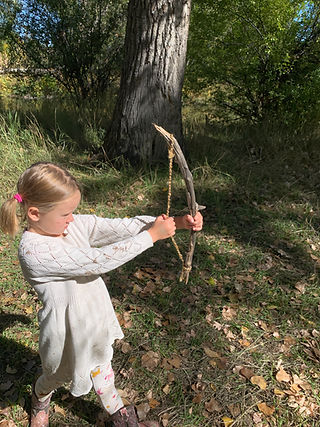
One moment she was sitting on the big flat rock by the creek — her rock, the one with the stripe of pink quartz running through the middle like a secret message — and the next moment a cottontail with one black-tipped ear was hopping along the trail, looking back at her like it was waiting.
So she followed.
The rabbit led her through the tall grass, past the cottonwood tree whose roots had grown into the shape of a sleeping giant, and into a part of the meadow she’d never noticed before. The grass here was silver-green, and the air smelled like rain even though the sky was perfectly clear. And right in the middle of it all, in a small sunlit clearing, were three children she had never seen before.

They were crouched behind a thicket of currant bushes. One had mud on both knees. One had a single blue feather tucked behind her ear. The third — the smallest one — pressed a finger to his lips the moment he saw Mira.
Shhh.
Mira crouched down beside them. Her heart was thumping.
“What are we hiding from?” she whispered.
The girl with the blue feather pointed.
At the edge of the clearing, sniffing the air with her long grey nose, was a coyote.
“Her name is Asha,” the girl with the feather said later, when Asha had moved on down the trail and they were all breathing normally again. “She knows this meadow better than any of us. She can hear a mouse sneeze from a hundred feet away. She can smell whether you had toast for breakfast.”
“She’s not dangerous,” the muddy-kneed boy added quickly, when he saw Mira’s face. “But she is the best finder in the whole watershed. If you move — even a little — she’ll see you. And then you’re out.”
“Out of what?” Mira asked.
All three of them grinned.
“The Sleeping Fawn Game,” said the small one.
The rules were simple, which Mira liked. When Asha — or sometimes Wolf, who came on cloudy days, or Cougar, who came on nights when the moon was new — when one of them appeared at the edge of the clearing, you had to find your hiding spot and go absolutely, completely, perfectly still.
Not pretend still. Not almost still. Fawn still.

“Have you ever seen a real fawn?” asked the girl with the feather. Her name was Sable, and she’d been playing the game since she was four. “When a fawn is born, it doesn’t run away from danger. It can’t — its legs aren’t strong enough yet. So instead, it lies down in the tall grass and disappears. Its spots look exactly like sunlight coming through leaves. It slows its breathing down. It doesn’t twitch. It doesn’t blink. It becomes part of the meadow.”
“And the predators just… walk right past?” Mira asked.
“If the fawn is still enough,” said Sable. “Yes.”
The first time Mira played, she was caught in seventeen seconds.
She had chosen a good hiding spot — behind the cottonwood root that looked like a sleeping giant — and she had held her breath and squeezed her eyes shut and tried very hard not to move. But then a small red ant walked across her ankle. And she flinched.
Asha’s amber eyes found her immediately.
“Out!” called Finn, the muddy-kneed boy, who was keeping score on a piece of bark with a sharp pebble.
Mira sat on the Sitting Rock — a mossy stone at the edge of the clearing designated for people who’d been found — and watched the others. Sable was invisible somewhere in the tall grass. Pip, the small one, had pressed himself against the bark of the cottonwood and gone so still that a yellow warbler landed on his shoulder.
A yellow warbler. Just landed there. Like he was a branch.
Mira had never wanted anything so much in her whole life.
She practiced every day that week.
First she practiced being still in her bedroom, just for one minute. Then five. Then she practiced outside, on her rock by the creek, just watching. She noticed things she had never noticed before: the way the creek sounded different in the morning than in the afternoon. The way the swallows flew low before a storm. The way a certain rustling in the grass almost always meant a meadow vole was running her invisible highways beneath the stalks.
She started to feel like the meadow was telling her things. Like it had been talking all along, and she just hadn’t been quiet enough to hear.
On the seventh day, she went back to the clearing.
Asha arrived just as the afternoon light turned golden.
Mira found her spot — not behind the cottonwood this time, but in the tall grass near the plum thicket, lying on her side, knees curled up just like a sleeping fawn. She let her breathing go slow. She let her eyes go soft. She felt the grass against her cheek. She felt the sun on her ear. She noticed a tiny spider building a web three inches from her nose, working in quick, focused spirals.
She did not move.
Asha padded through the clearing. She sniffed left. She sniffed right. She looked straight at the place where Mira was lying.
And then she moved on.

Afterward, when Asha had gone and the four of them were sprawled on the warm flat rocks sharing a handful of red and golden currants Finn had found, Mira said something she hadn’t planned to say.
“I think I understand why the fawn does it,” she said. “It’s not just about hiding. It’s about belonging. When you’re still enough, you stop being a visitor. You become part of the meadow.”
Sable looked at her with one eyebrow raised. Then she smiled the kind of smile that meant yes, exactly, that’s the whole thing.
“The game never really ends,” Sable said. “Even when there’s no coyote. You can come back to your spot any time — any day, any season — and practice being still. Practice listening. Practice being part of it instead of just passing through.”
“Do you have a spot?” Mira asked.
Sable nodded toward the tall grass where she’d been invisible for twenty full minutes that afternoon.
Mira looked at the flat rock with the pink quartz stripe — her rock, the one by the creek.
“I think I already have mine,” she said.
Welcome, Dia dhuit, É-peve-éšeeva, Nii’óókoh’uusini, Kia ora, Bienvenidos
Want to try the Sleeping Fawn game? Find a spot outside that feels right — a corner of the yard, a park, a trail. Sit very still. Breathe slowly. See how long it takes before a bird forgets you’re there. That’s your sit spot. It will teach you things — different things every time — if you keep coming back.
At Mycelium Cooperative, we play games like this with learners of all ages in the Cherry Creek and Bear Creek Watershed of Aurora and Denver, Colorado. If you’d like to join us, we’d love to meet you. Come find us here.


And maybe even lovelier as a story version... not just for children! : ) Thank you for sharing!